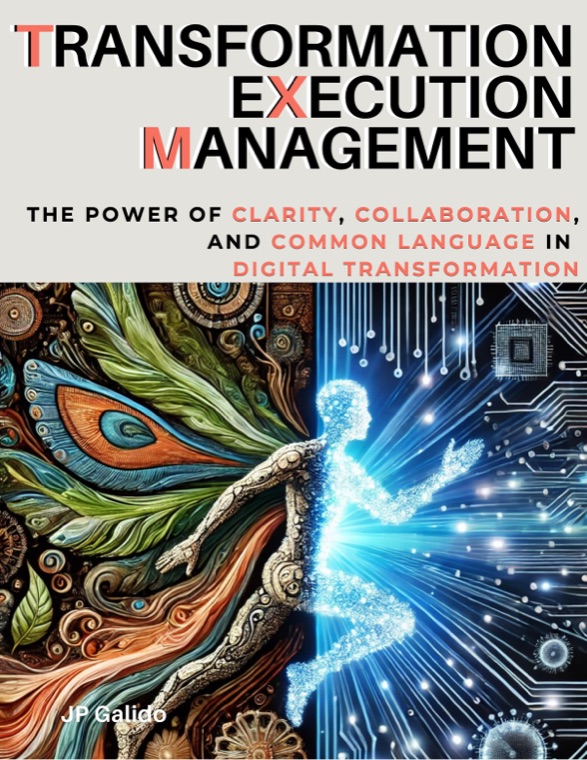
Before I called the role Business AI Architect, I was trying to solve a harder problem:
Why do good strategies, good software, and good teams still fail when transformation reaches the real organization?
That question became Transformation Execution Management — TXM:
the framework I developed and authored for helping leaders move from intent to execution with more
discipline, more evidence, and less theater. It treats transformation as a system — decisions,
constraints, roles, incentives, process, technology, adoption, governance, and the human resistance that
shows up when change becomes real.
Business AI Architecture grew from that same foundation. In the AI era, the work isn’t only about
managing projects or deploying software. It’s about designing the execution system around the work:
- What should be deterministic?
- What should be AI-assisted?
- What should require human approval?
- What evidence is needed before a decision is trusted?
- What workflow will people actually use?
- What changes when the bottleneck is no longer information, but judgment?
TXM gives the execution discipline.
TXMBOK gives the body of knowledge.
Business AI Architecture applies that discipline to AI-enabled work.
Framework · Authored by JP Galido
Transformation Execution Management — Body of Knowledge
TXMBOK is the structured body of knowledge behind my approach to transformation execution. It brings
business architecture, enterprise systems, governance, adoption, decision quality, and delivery
discipline into one execution-centered framework.
It’s the foundation I use when designing governed AI systems, miniapps, transformation control
models, and Business AI Architecture patterns.
View TXMBOK ↗
Business AI Architecture is my answer to the gap between AI capability and enterprise execution. Most
organizations don’t fail because the model can’t generate an answer — they fail because
nobody redesigned the system around the answer.
The Business AI Architect sits in that gap. Not just business, not just technology, not just AI, not just
change management — the role connects the whole execution system: business intent, process, data,
application logic, governance, human decisions, risk, compliance, and AI capability. This is the role I
believe more organizations will need as AI moves from experiments into operating models.
Fiction · Authored by JP Galido
The AIchitect: Collision
I also wrote a novel to explore what this role becomes in practice. Fiction gave me a way to show the
human side of the work — the meetings, the doubts, the politics, the decisions and mistakes, the
moments where AI forces people to rethink how execution really happens.
It isn’t just a story about AI. It’s a story about the person who has to make AI useful,
governed, trusted, and real inside an organization. When perfect systems create perfect chaos.
View the book ↗
AI changes the cost of creating outputs. It doesn’t remove the need for execution judgment. In many
organizations, AI will make weak execution more visible, not less: more ideas become prototypes, more
prototypes become demos, more demos create pressure to deploy. But deployment still requires trust,
process, ownership, controls, adoption, and accountability.
TXM is the execution foundation.
TXMBOK is the body of knowledge.
Business AI Architecture is the role for the AI era.
Miniapps are the product form that makes it practical.
The goal isn’t to make AI sound impressive. The goal is to make enterprise work more navigable, more
honest, and more executable.